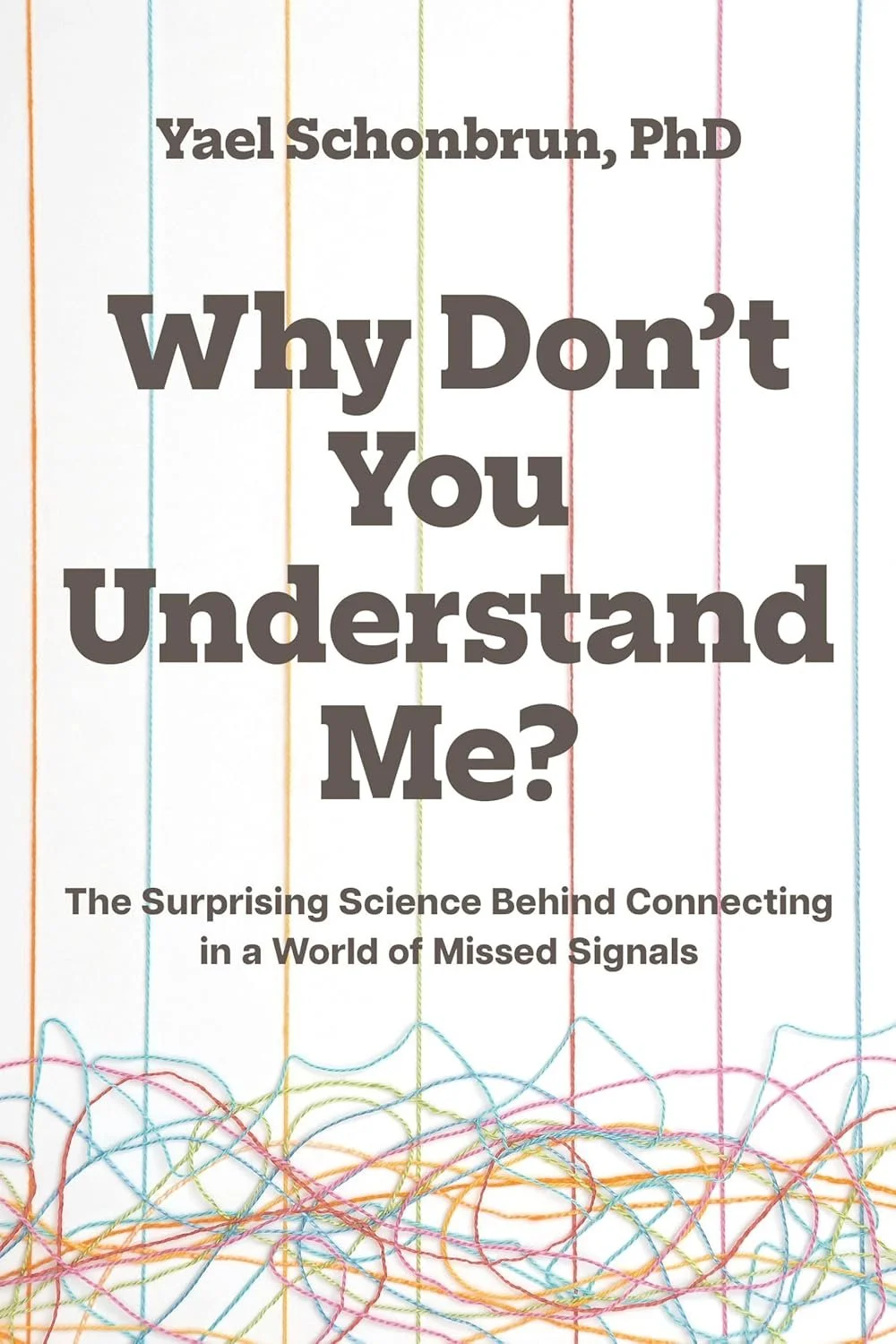

Pre-order Why Don’t You Understand Me? Today
About the Book
You said exactly what you meant. They still didn't get it.
You've had the conversation. Maybe more than once. You chose your words carefully, kept your tone reasonable, did everything right, and somehow still ended up more distant (and far more frustrated) than when you started.
We often assume it’s a communication problem. But more often, it's a perception problem.
We've spent decades being told that misunderstanding is a communication problem. We’ve long been told that the right words, a softer tone, and more active listening will close the gap between us. But the research suggests something different: people can execute every prescribed communication behavior flawlessly and still completely miss each other. That's because understanding doesn't happen between people in the exchange of words. It happens inside each of us.
Understanding is shaped by the ambiguity of language and a cast of internal culprits you'll recognize immediately: overconfidence in your ability to read the room (and your partner), memory that rewrites itself to protect your ego, a deep hunger for shared reality that can make you see what you expect rather than what's there, and it turns out, the literal hunger that makes you think everyone is evil. (Snack before difficult conversations. This is evidence-based advice.)
Why Don't You Understand Me? follows that idea into unexpected territory. You'll sit beside the Exalted Cyclops of Durham's Ku Klux Klan and the city's prominent Black civil rights leader as understanding transforms lifelong hatred into friendship. You'll join a detective alone in a room with a serial killer, watching generous understanding extract a confession. You'll visit a therapy room where two people who love each other can't understand why they remember the same fight so differently. And you'll find out what being understood by an octopus reveals about human connection itself.
Drawing on two decades in the therapy room and powerful relationship science, Dr. Schonbrun traces the hidden forces that distort what we perceive, how we interpret it, and why we defend our version of events even when we're wrong — then shows what to do about it.
Why Don't You Understand Me? isn’t a how-to. It's a fundamental reframe that makes the familiar suddenly strange, and then, finally, navigable.
Early Praise for Why Don’t You Understand Me?
“An eye-opening book about how to avoid misunderstandings. Combining her empathy as a therapist, rigor as a scientist, and clarity as a teacher, Yael Schonbrun reveals how we can get better at building bridges. It’s tailored-made for this moment.”
— Adam Grant, #1 New York Times-bestselling author of Vibe and Think Again, and host of the podcast Re:Thinking

“Read this propulsive, paradigm-shifting book and all your interactions with other people will change for the better. Why Don’t You Understand Me?is more than a book: it’s a fascinating life hack explaining why we misunderstand each other even when we think we’re communicating clearly. If you’ve ever wondered why your communication with someone feels unsatisfying, here is your answer and your solution. I loved this book! It has my highest recommendation.”
— Lindsay C. Gibson, PsyD, New York Times–bestselling author of Adult Children of Emotionally Immature Parents and How to Raise an Emotionally Mature Child
“I loved this book. The application of research is so convincing that our perceptions are actually mostly biased. We’re so sure we’re right that it impedes true understanding. And then, when we least expect it, the book offers a solution to the basic problem of why it’s so hard to really understand one another. Buy this book if you care about communication!”
— John M. Gottman, PhD, New York Times–bestselling co-author of Fight Right and The Seven Principles for Making a Marriage Work

“Yael Schonbrun offers us a surprisingly practical guide to solving the deepest of human needs—being understood! With rigorous research and heartwarming stories, she offers the reader a path toward less distress and greater belonging.”
— Julia A. Minson, professor of Public Policy, Harvard Kennedy School; bestselling author of How to Disagree Better

“So much of our suffering in relationships, at work, and within families lives in the gap between what we meant and what was heard, and Yael Schonbrun has written the most illuminating guide I've encountered for bridging that distance. Why Don't You Understand Me? names the hidden forces that cause even the most caring, attentive people to miss one another and offers a path to the kind of connection that makes us feel genuinely seen and valued. This is a book about communication, yes — but even more, it's a book about what it takes to truly matter to the people who matter most to you.”
— Jennifer Wallace, New York Times-bestselling author of Mattering: The Secret to a Life of Deep Connection and Purpose

Why Don’t You Understand Me? is a wise, wonderful guide to why we so often misunderstand each other—even when we’re sure we’re being clear. Yael Schonbrun shows how emotions, biases, and fears shape what we hear, what we miss, and how to move through conflict with more grace, guts, and care.
— Marc Brackett, Director, Yale Center for Emotional Intelligence and bestselling author of Dealing with Feeling and Permission to Feel
“I have read a lot of books about communication and conflict, and this one stands out. It’s based on rigorous research, which is rare, and it’s filled with actionable advice. But what really got me were the stories. Dr. Schonbrun tells stories about real people grappling with the limitations and wonder of relationships. These are the kinds of stories that make us feel understood, just by reading them.”
— Amanda Ripley, author of High Conflict; co-founder, Good Conflict

Yael Schonbrun has written a clear-eyed guide to one of the most frustrating experiences in relationships: feeling misunderstood. With rigorous science and real humanity, she offers a clarifying way beyond the usual communication advice to something more fundamental - and more helpful. I regularly work with people navigating difficult relationships, and I'll definitely be pointing them to this book.
— Amy Gallo, author of Getting Along: How to Work with Anyone (Even Difficult People) and contributing editor at Harvard Business Review
What You'll Walk Away With
A new understanding of why misunderstanding is inevitable and why that might be the most relieving thing you'll read all year
Insight into the usual suspects behind your worst misunderstandings, from cognitive biases to how we feel physically to the ambiguity of language
A toolkit for the moments that matter most, including generous understanding, taking the poison (yes, really), dropping the rope, sharing the project, and the surprisingly powerful role of humor in bridging divides
Practical strategies for the fight that keeps happening, the colleague you can't reach, and the political divide that feels unbridgeable
A richer, more forgiving view of why the people you love see things so differently than you do, and what to do about it anyway
Who This Book Is For
This book is for the curious reader who loves science but hates being lectured.
It's for the leader who has watched a talented team talk past each other and wondered if there's a better explanation than ‘people are difficult.’ (There is.)
It's for the couples therapist who wants to understand why the tools work when they do.
It's for anyone who suspects that the way we've been thinking about human connection might be missing something fundamental.
It's for anyone who has ever felt chronically misunderstood, whether in marriage, friendships, the workplace, or their country.
Pre-order Why Don’t You Understand Me? Today
Pre-Order Today to Receive Exclusive Bonuses
If you pre-order the book today, you will receive the following bonuses the week before it launches.
Pre-order now and you'll receive:
A Guide on the Misunderstanding Cycle (and How to Break It)
Suggested Scripts for the Chronically Misunderstood (And for Those of Us Who Occasionally Do the Misunderstanding Ourselves)
An Exclusive Invitation to an Online Workshop on How to Apply the Lessons from the Book
How to Get Your Bonuses
1. Pre-order Why Don’t You Understand Me? from your favorite bookseller.
2. Fill out this form to receive your bonuses.
Note: if you order directly from your indie bookshop, that's great too! You'll be able to indicate that in the form.
About Yael Schonbrun, PhD
I'm a clinical psychologist, couples therapist, and assistant professor at Brown University, and I've spent two decades watching smart, well-meaning people talk past each other in the most important relationships of their lives (Don’t bother doing the age math–I started very young).
It turns out the problem isn't them. It's how understanding actually works.
I've made it my mission to drag the science on this out of academic journals and into real conversations, real relationships, and real lives with a little humor (because relationships are hard enough without them being boring too).